DSPi
Free & openPacking some of the industry's most expensive functionality into a $1 microcontroller.
RP2040RP2350
Get it free
Eight channels of digital audio from S/PDIF, ADAT, I2S or TDM into any computer. No drivers.
over one optical fibre, driverless
Picorder turns a Raspberry Pi Pico into a digital audio recorder for your computer. Connect a digital source and it appears as an ordinary USB recording device with up to eight channels. No drivers are needed on macOS, Windows or Linux.
It accepts six kinds of input. S/PDIF and ADAT lightpipe take audio from equipment such as CD transports, TVs and studio preamps. I2S and TDM connect directly to audio converter chips and can either supply their clock or follow it. I2S carries up to four stereo pairs, while TDM fits eight channels onto a single wire.
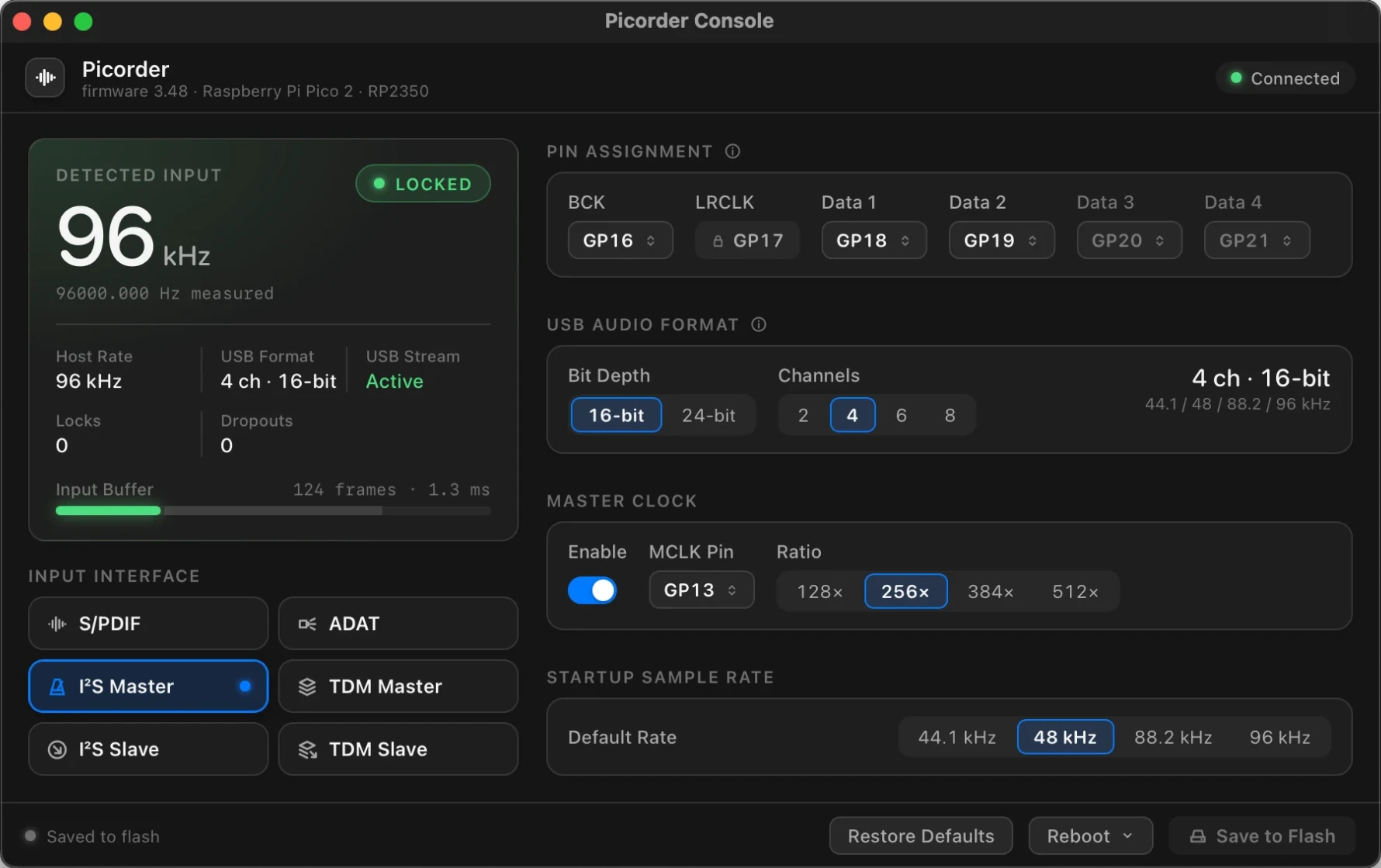
Setup happens in Picorder Console for Windows, macOS and Linux. You choose the input, the pins it uses and the recording format. Changes take effect straight away without reflashing or replugging the Pico. Settings are saved on the device, so it starts up the same way next time.
Picorder never resamples your audio. It keeps the USB stream locked to the source's own clock instead. If the source runs at a different sample rate from the one your computer expects, Picorder records silence and flags the mismatch. Your recording never plays back at the wrong pitch.